How should wisdom be transmitted from one generation to the next when the world itself changes rapidly?
Both Khalil Gibran and Rabindranath Tagore anticipated this challenge long before the digital age.
Preparing Children for Tomorrow, Not Yesterday
*Lessons from Khalil Gibran and Rabindranath Tagore*
More than a century ago, two remarkable thinkers expressed ideas that seem almost prophetic today.
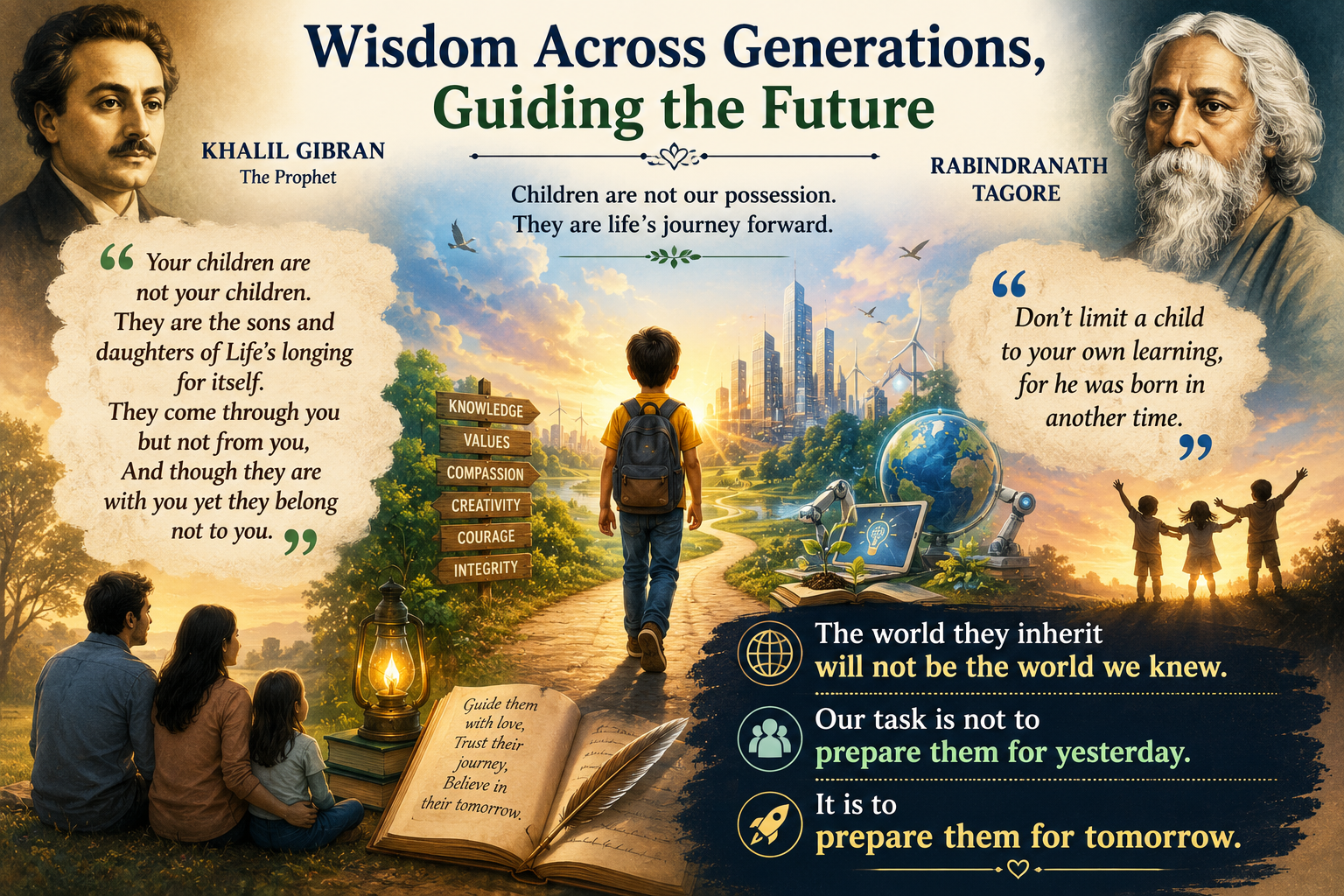
Khalil Gibran wrote in *The Prophet*:
> “Your children are not your children.
> They are the sons and daughters of Life’s longing for itself.
> They come through you but not from you,
> And though they are with you yet they belong not to you.”
Rabindranath Tagore similarly observed:
> “Don’t limit a child to your own learning, for he was born in another time.”
These are not merely poetic expressions. They are educational philosophies that challenge every generation of parents and teachers.
Their central message is simple:
**Children are not meant to become replicas of their parents. They are meant to become citizens of a future their parents may never fully experience.**
## Love Then and Love Now
Perhaps no subject demonstrates this change more vividly than romantic relationships.
For much of the twentieth century, communication was slow.
A young woman might wait weeks or even months for a letter from the man she loved. If no letter arrived, she blamed the postal service, uncertain whether the message had been delayed or lost. Literature and cinema from that era are filled with stories of lovers separated by distance, misunderstanding, and silence.
Songs about waiting endlessly for a beloved resonated deeply because they reflected everyday reality.
Today, the situation is entirely different.
A message travels across continents in seconds. Video calls connect people separated by thousands of kilometres. Social media often reveals very quickly whether affection is mutual or one-sided.
Many misunderstandings that once lasted years now dissolve within days—or even hours.
This technological shift has changed not only communication but also expectations.
Many young people today are less willing to remain indefinitely in uncertain or unhealthy relationships. They may decide earlier that a relationship lacks mutual respect or commitment and move on.
Technology has reduced some forms of uncertainty, although it has also introduced new challenges such as online misrepresentation, digital harassment, and information overload.
A Different Generation
Every generation grows up under different circumstances.
Today’s young people inherit a world shaped by:
* Instant communication
* Artificial intelligence
* Global employment opportunities
* Online education
* Greater awareness of mental health
* Increased discussions about equality and workplace dignity
Many occupations that are respected today did not even exist a few decades ago.
Likewise, ideas such as entrepreneurship, remote work, digital content creation, and the dignity of diverse professions have become far more visible.
It is therefore natural that today’s youth often approach life differently from their grandparents.
Education for the Future
This raises an important question.
If students continue to experience overwhelming academic pressure, anxiety, or hopelessness in a rapidly changing world, should education evolve?
Knowledge remains essential, but education also needs to cultivate qualities such as:
* Critical thinking
* Emotional resilience
* Ethical decision-making
* Communication skills
* Financial literacy
* Digital literacy
* Creativity
* Problem-solving
* Respectful relationships
* Adaptability
Examinations should measure learning, not determine a person’s worth.
No child should feel that one examination defines an entire life.
The Role of Parents and Teachers
Parents and teachers are not expected to know every future technology.
Their deeper responsibility is to nurture qualities that remain valuable across every era:
* Integrity
* Compassion
* Curiosity
* Responsibility
* Courage
* Respect for others
* A lifelong willingness to learn
These values prepare children not merely for one career, but for a lifetime of change.
A Timeless Lesson
Gibran reminded us that children belong to the future.
Tagore reminded us that they are born into a different age.
Perhaps the greatest gift we can offer the next generation is not to insist that they relive our past, but to equip them with the wisdom and character to navigate **their** future.
The world they inherit will not be the world we knew.
Our task is not to prepare them for yesterday.
It is to prepare them for tomorrow.